Does your car mention EyeSight, Honda Sensing or Ford Co-Pilot360? Find your brand below to translate the names you see and learn which equipment matters when replacing your windshield.
Tap a name to open its guide. Use the links below if you are not sure what to look for.
ADAS means advanced driver assistance systems. These are common current and earlier U.S. names across 37 brand groups. Your model year, trim, options and software determine what is fitted. A brand listing is not a promise that every feature or service is available for your vehicle.
Photos and menu names help with identification. They do not replace checking the glass specification, fitted equipment and manufacturer service information.
Look around the mirrorLook for: AcuraWatch; AcuraWatch 360 on 2025 MDX Type S with Advance Package; AcuraWatch 360+ on electric ZDX Type S.
Lane help: Warning: Lane Departure Warning (LDW). Correction: Road Departure Mitigation (RDM). Centering: Lane Keeping Assist System (LKAS), with Traffic Jam Assist on equipped models.
Following traffic: Adaptive Cruise Control (ACC) with Low-Speed Follow on applicable models. ZDX Type S's Hands Free Cruise is a separate supervised feature for eligible roads and conditions.
Crash help: Forward Collision Warning (FCW) provides alerts. Collision Mitigation Braking System (CMBS), with Pedestrian Detection or Advanced Pedestrian Detection wording, can brake.
Other names: Blind Spot Information (BSI); Rear Cross Traffic Monitor; Traffic Sign Recognition; Automatic High Beams. Multi-View Rear Camera differs from the available Surround-View Camera System. MDX AcuraWatch 360 adds Active Lane Change Assist, Lane Change Collision Mitigation and Front Cross Traffic Warning.
Windshield note: The updated 2024 TLX and 2025 MDX AcuraWatch use a single-lens front camera plus grille radar. MDX Type S's 360 package adds corner radars and different front hardware. Camera identification and windshield calibration must follow the actual model's procedure.
Check your version: Electric ZDX specifications use Forward Collision Alert, Automatic Emergency Braking, Front Pedestrian Braking, Lane Keeping Assist, Side Blind Zone Alert, Lane Change Alert, Rear Cross Traffic Alert and Rear Cross Traffic Braking. Its AcuraWatch 360+ is different from MDX's AcuraWatch 360; the similar names do not establish identical sensors or capabilities.
Look for: Active Driver Assistance Package, Lane Keep Assist, LaneSense or Traffic Jam and Highway Assist. Alfa DNA driving modes are a different system.
Lane help: Lane Departure Warning alerts you. Lane Keep Assist/Lane Keeping Assist, or LaneSense Lane Keep Assist on the documented Tonale, adds correction. Highway Assist System (HAS) and Traffic Jam Assist (TJA) combine cruise with lane-centering support.
Following traffic: Adaptive Cruise Control (ACC), sometimes called Active Cruise Control in marketing. Newer Tonale materials also use Active Driving Assist; confirm its exact equipment and software.
Crash help: Full-Speed Forward Collision Warning-Plus and Forward Collision Warning with Full Stop are recognition names for forward warnings/braking assistance. Confirm braking settings and pedestrian detection in the selected manual.
Other names: Blind Spot Monitoring with Rear Cross Path Detection; Active Blind Spot Assist; Traffic Sign Recognition; Intelligent Speed Assist/Control; Auto High Beam Headlamp Control; Front and Rear Park Assist/ParkSense, backup camera and available Tonale 360° Camera.
Windshield note: The 2024 Stelvio US manual says HAS uses front-camera and radar information and requires hands on the wheel. Its road-facing camera is separate from parking-camera views. Verify glass and calibration requirements by VIN.
Check your version: Giulia/Stelvio and Tonale have different systems. The 2025 Tonale's available four-camera overhead view is a model-specific example. Check your own equipment list and manual.
Look for: Audi pre sense, Audi active lane assist or adaptive cruise assist. On the all-new US 2025 Q5, also look for Active Front Assist.
Lane help: Lane departure warning and Audi active lane assist can alert or correct drift, depending on generation/settings. Adaptive Cruise Assist/Adaptive Cruise Control with Lane Guidance is the combined system to check for ongoing lane-centering support.
Following traffic: Adaptive Cruise Control; Adaptive Cruise Control with Traffic Jam Assist on certain A4/A5/Q5 models; traffic-sign-based adaptive cruise control on the new 2025 Q5.
Crash help: Audi pre sense city/front can warn and brake. pre sense basic alone primarily prepares occupants/vehicle. New Q5 Active Front Assist includes Front Emergency Brake Assist, Evasion Assist, Turn Assist and Front Cross Traffic Assist. Verify pedestrian detection for the exact version.
Other names: Audi side assist; Rear Cross Traffic Alert/rear cross traffic assist; Traffic sign recognition; High-beam assist; Parking system plus, 360-degree/top views and Park Assist Plus.
Windshield note: Audi identifies a camera behind the windshield for pre sense city. Other pre sense versions and parking/blind-spot functions use different combinations. Match glass and required calibration to the actual vehicle.
Check your version: New and older Q5 models use different names. A pre sense message or package name does not confirm every feature.
Look for: Active Driving Assistant, Driving Assistance Plus or Driving Assistance Professional. In iDrive, the useful words are Driver Assistance, Assisted Driving and Distance Control.
Lane help: Lane Departure Warning warns of drift. Lane Keeping Assistant can add a corrective nudge. Steering Assistant in Assisted Driving Mode provides lane-centering support. BMW expressly says Lane Keeping Assistant alone does not center the vehicle.
Following traffic: Distance Control and Active Cruise Control with Stop & Go adjust speed to a selected following distance. Conventional cruise is different.
Crash help: Frontal Collision Warning alerts you. Forward Collision Mitigation, also called Frontal Collision Mitigation, can add automatic braking; detected hazards and limits depend on the vehicle.
Other names: Active Blind Spot Detection; Cross Traffic Warning; Speed Limit Info/Speed Limit Assistant; High Beam Assistant; Parking Assistant/Plus, Parking View, Park Distance Control and Back-Up Assistant.
Windshield note: A road-facing camera can support lane and forward-collision features; BMW also describes camera/radar combinations. Parking and blind-spot equipment should not all be treated as windshield-camera functions. Verify the exact glass and calibration procedure by VIN.
Check your version: The 2025 2 Series Gran Coupe has documented package differences. Highway Assistant/Assisted Driving Plus are separately equipped supervised features. Do not infer hands-free capability from Active Driving Assistant.
Look for: Buick Driver Confidence is the familiar safety-bundle name. Super Cruise is available on equipped Enclave models.
Lane help: Lane Departure Warning alerts; Lane Keep Assist with Lane Departure Warning briefly corrects drift. Sustained centering through Super Cruise is a separate capability, first available on the 2025 Enclave.
Following traffic: Adaptive Cruise Control adjusts speed and following distance. Following Distance Indicator reports the gap and does not prove adaptive cruise is installed.
Crash help: Forward Collision Alert warns. Automatic Emergency Braking and Front Pedestrian Braking may brake. Some newer models add Enhanced Automatic Emergency Braking and Intersection Automatic Emergency Braking.
Other names: IntelliBeam Auto High Beams, Lane Change Alert with Side Blind Zone Alert, Rear Cross Traffic Alert/Braking, Blind Zone Steering Assist, Traffic Sign Recognition and HD Surround Vision are model-dependent names.
Windshield note: A fitted windshield camera supports forward-road assistance. HD Surround Vision and Rear Camera Mirror concern other camera views. Confirm the actual camera and windshield specification by VIN; Buick-specific service information determines any required calibration.
Check your version: The 2023 Envision brochure documents Driver Confidence's six features; the 2025 Enclave lists newer equipment and optional Super Cruise. Do not assume every Buick has those options or that a rearview-mirror screen proves windshield ADAS equipment. Driver supervision is always required.
Look for: Cadillac Smart System is a suite; Active Safety/Driver Assist packages and Super Cruise vary by vehicle.
Lane help: Lane Departure Warning alerts. Lane Keep Assist with Lane Departure Warning provides correction; selected vehicles say Enhanced Lane Keep Assist. Do not infer continuous centering from that name alone. Super Cruise supplies separately equipped sustained assistance.
Following traffic: Adaptive Cruise Control manages speed and gap; it is distinct from Following Distance Indicator.
Crash help: Forward Collision Alert warns. Automatic Emergency Braking, Front Pedestrian Braking, Enhanced Automatic Emergency Braking and Intersection Automatic Emergency Braking describe different fitted braking capabilities.
Other names: Lane Change Alert with Side Blind Zone Alert, Blind Zone Steering Assist, Rear Cross Traffic Braking, IntelliBeam, Traffic Sign Recognition, HD Surround Vision and Enhanced Automatic Parking Assist. Safety Alert Seat is a warning method, not a camera.
Windshield note: A fitted windshield road camera, driver-monitoring camera and surround-view cameras have different purposes. Confirm the exact sensor arrangement and glass by VIN. Current Cadillac service procedures determine windshield-camera calibration requirements.
Check your version: The 2024 XT4 source separates Smart System from added features; the 2025 CT5 V-Series brochure uses Enhanced Lane Keep Assist. Neither establishes identical equipment on older Cadillacs. Super Cruise is supervised driver assistance, and availability must be verified.
Look for: Chevy Safety Assist is a six-feature bundle. Super Cruise is a separate available driving-assistance capability.
Lane help: Lane Departure Warning alerts; Lane Keep Assist with Lane Departure Warning can give a brief steering correction. That is different from sustained centering through an equipped Super Cruise system.
Following traffic: Adaptive Cruise Control manages speed and following distance. Following Distance Indicator only displays a gap measurement; it is not adaptive cruise.
Crash help: Forward Collision Alert warns. Automatic Emergency Braking and Front Pedestrian Braking may brake. Some newer models add Enhanced Automatic Emergency Braking or Intersection Automatic Emergency Braking.
Other names: Lane Change Alert with Side Blind Zone Alert, Rear Cross Traffic Alert/Braking, IntelliBeam Auto High Beams and HD Surround Vision. Certain newer models add Blind Zone Steering Assist and Traffic Sign Recognition.
Windshield note: The 2024 Silverado manual warns that replacement windshields on front-camera-equipped vehicles must meet GM's installation/alignment specifications. A surround-view parking image does not identify that windshield camera. The exact VIN-specific GM procedure determines calibration work.
Check your version: Chevy Safety Assist does not guarantee ACC, blind-spot monitoring, surround vision or Super Cruise. The 2024 Traverse has newer feature names that may differ from an older Chevrolet. The driver remains responsible.
Look for: LaneSense, ParkSense and model-specific Safety Sphere Package. These names cover different jobs rather than one universal Chrysler suite.
Lane help: LaneSense Lane Departure Warning alerts; LaneSense with Lane Keep Assist adds corrective steering. It should not be treated as a separate continuous lane-centering system.
Following traffic: Adaptive Cruise Control with Stop and Go helps manage speed and following distance. Check the actual equipment list rather than a generic cruise-control button.
Crash help: Full-Speed Forward Collision Warning with Active Braking combines warning and potential braking. Pedestrian Automatic Emergency Braking System is another recognizable current Pacifica label.
Other names: Blind Spot Monitoring System, Rear Cross Path Detection, 360° Surround View Camera and ParkSense Front/Rear Park Assist. The 2027 Pacifica source adds automatic high beams and an upgraded Safety Sphere with blind-spot camera views.
Windshield note: The 2025 Pacifica manual identifies the forward-facing camera used by LaneSense. FCA US's glass bulletin requires recalibration after windshield installation when a forward-facing camera is fitted. Follow the current VIN-specific procedure.
Check your version: A Voyager or older Chrysler may have different equipment from a 2026 Pacifica. The 2027 camera-view additions differ from earlier years. FamCAM watches passengers inside; it is not the forward-road camera. Check your manual for sign-recognition equipment.
Look for: LaneSense, Active Driving Assist, ParkSense and ParkView. There is no single all-model package name that guarantees their presence.
Lane help: Durango's LaneSense Lane Departure Warning alerts and Lane Keep Assist corrects drift. Active Driving Assist on equipped newer vehicles provides sustained driving assistance; the 2026 Charger requires appropriate hands-on supervision.
Following traffic: Adaptive Cruise Control with Stop is the Durango name for speed/following-distance control.
Crash help: Durango uses Forward Collision Warning with Full Stop; the 2026 Charger uses Forward Collision Warning Plus. These systems can warn and, within their operating conditions, apply emergency braking.
Other names: Blind Spot Monitoring, Rear Cross Path Detection and trailer-aware blind-spot monitoring on equipped Durango. Charger names include Traffic Sign Recognition, Turn Signal Activated Blind Spot, 360º Surround View Camera and ParkSense with Camera. Durango's Automatic High Beam setting is Auto Dim High Beams in Uconnect.
Windshield note: 2026 Charger FCW Plus specifically uses forward-camera and radar inputs. Its parking views use separate front, rear and side cameras. For a windshield-mounted forward camera, FCA US's glass bulletin requires recalibration after windshield installation using the applicable procedure.
Check your version: Durango, Hornet and Charger can have different capabilities even when feature names overlap. Confirm year, VIN, trim and software. A parking-camera display does not prove the windshield-camera configuration.
Look for: A newer US 500e may say Co-Driver, Lane Control or LaneSense. An older 500, first-generation 500e or 500X needs a separate equipment check.
Lane help: LaneSense, Lane Control and Active Lane Management are departure-support names; versions can warn, correct steering or both. Co-Driver with Follow to Stop-Traffic Jam Assist or Co-Driver with Stop & Go is the separate cruise-and-centering system.
Following traffic: Adaptive Cruise Control (ACC); Stop & Go and Intelligent Adaptive Cruise Control variants. Conventional Speed Control alone does not establish following-distance control.
Crash help: Autonomous Emergency Braking (AEB)/Forward Collision Warning; Automatic Emergency Braking; Pedestrian Emergency Braking. The 2024 500e manual distinguishes warning-only from warning-plus-active-braking settings.
Other names: Blind Spot Monitoring; Blind Spot and Rear Cross Path Monitoring; Traffic Sign Recognition; Intelligent Speed Assist; Automatic High Beam Headlamp Control/Auto Dim High Beams; ParkSense and ParkView Rear Back Up Camera.
Windshield note: The 2024 500e manual identifies a windshield camera for Co-Driver. Its high-beam section calls for mirror re-aiming after windshield/high-beam-mirror replacement. The complete VIN-specific procedure determines all required ADAS checks.
Check your version: The 2023 500X LaneSense system differs from newer 500e Co-Driver equipment. Manual descriptions can include optional equipment; Co-Driver remains hands-on assistance.
Look for: Ford Co-Pilot360 and Co-Pilot360 2.0 are package names. Ford BlueCruise is a separately equipped highway-assistance capability.
Lane help: Lane-Keeping Alert warns; Lane-Keeping Aid gives a brief correction. Both belong to Lane-Keeping System. Lane Centering or Lane Centering Assist provides sustained support. BlueCruise adds supervised hands-free assistance where available.
Following traffic: Adaptive Cruise Control with Stop-and-Go; Intelligent Adaptive Cruise Control on equipped versions. Ordinary cruise control does not establish adaptive speed or following-gap control.
Crash help: Forward Collision Warning warns. Pre-Collision Assist with Automatic Emergency Braking can apply the brakes when its conditions are met.
Other names: BLIS (Blind Spot Information System), Cross-Traffic Alert, Auto High-Beam Headlamps, Speed Sign Recognition and 360-Degree Camera are recognizable labels. Newer vehicles may add Blind Spot Assist or Reverse Brake Assist.
Windshield note: The 2024 F-150 manual identifies a forward camera and a radar sensor if equipped. The windshield camera and separate radar have different locations. Ford's glass statement calls for applicable ADAS recalibration after windshield replacement using its repair procedures.
Check your version: Package contents differ by model, year and trim. Match the VIN and original equipment list; do not assume every Co-Pilot360 vehicle has radar, ACC, 360° cameras or BlueCruise. All assistance requires an attentive driver.
Look for: Genesis driver-assistance features and Highway Driving Assist/HDA2. HDA is one capability, not the name for all safety equipment.
Lane help: Lane Departure Warning alerts; Lane Keeping Assist (LKA) corrects unintended drift. Lane Following Assist (LFA) provides sustained centering, with Highway Driving Assist adding coordinated highway support.
Following traffic: Smart Cruise Control (SCC) and Navigation-based Smart Cruise Control (NSCC). Older G80 material says Smart Cruise Control with Stop/Start.
Crash help: Forward Collision-Avoidance Assist (FCA) includes collision warnings and potential braking. Earlier vehicles may say Automatic Emergency Braking (AEB). Junction and evasive functions depend on equipment.
Other names: Blind-Spot Collision-Avoidance Assist, Blind-Spot Collision Warning, Blind-Spot View Monitor, Rear Cross-Traffic Collision-Avoidance Assist, Intelligent Speed Limit Assist, High Beam Assist and Surround View Monitor. Earlier G80 names include Blind Spot Detection and Rear Cross-Traffic Alert.
Windshield note: The 2025 G70 highway/cruise documentation and 2026 FCA Sensor Fusion manual identify front-view camera plus front radar. This supports that model example only. Confirm windshield glass, sensor fitment and calibration requirements using Genesis service information for the VIN.
Check your version: 2017 G80 and newer G70 terminology differ. Look under Setup > Vehicle > Driver Assistance for settings. Do not equate the former Hyundai Genesis sedan with every Genesis-brand model. HDA remains supervised assistance with applicable hands-on requirements.
Look for: GMC Pro Safety and GMC Pro Safety Plus are bundles; Super Cruise is separately equipped assistance.
Lane help: Lane Departure Warning alerts; Lane Keep Assist with Lane Departure Warning gives corrective assistance. Super Cruise provides sustained lane support. Select 2026/2027 Super Cruise-equipped models also offer Hands-On Steering Assist, listed under Vehicle > Lane Centering Assistance.
Following traffic: Adaptive Cruise Control manages speed and following distance. A Following Distance Indicator does not itself adjust speed.
Crash help: Forward Collision Alert warns. Automatic Emergency Braking and Front Pedestrian Braking can apply braking within their limits.
Other names: Lane Change Alert with Side Blind Zone Alert, Rear Cross Traffic Alert, IntelliBeam Auto High Beams and HD Surround Vision. Trailer Side Blind Zone Alert and Traffic Sign Recognition are equipment-dependent names.
Windshield note: The 2025 Sierra HD manual addresses windshield replacement on vehicles with a front camera. Camera alignment and the exact GM procedure matter. Grille/bumper radar, trailer cameras and surround-view cameras are separate from windshield sensing.
Check your version: 2023 Sierra and 2022 Yukon brochures document different Pro Safety package contents. The 2026 Terrain Technology Package II lists sign recognition and surround vision. Confirm VIN/build, especially on vehicles affected by equipment substitutions. Hands-free assistance still needs an attentive driver.
Look for: Honda Sensing. Honda LaneWatch on selected older vehicles is a passenger-side camera-view aid, different from Blind Spot Information.
Lane help: Warning: Lane Departure Warning (LDW), often within Road Departure Mitigation (RDM). Correction: RDM. Centering: Lane Keeping Assist System (LKAS), with Traffic Jam Assist for lower-speed assistance on equipped models.
Following traffic: Adaptive Cruise Control (ACC); ACC with Low-Speed Follow where supported. Availability and operating range vary with model and transmission.
Crash help: Forward Collision Warning (FCW) alerts the driver. Collision Mitigation Braking System (CMBS) can brake automatically; pedestrian detection depends on the version.
Other names: Blind Spot Information System; Cross Traffic Monitor; Traffic Sign Recognition (TSR); Auto High-Beam Headlights. Multi-Angle Rearview Camera provides rear views; Multiview Camera System on selected Pilot trims supplies surrounding views.
Windshield note: The 2022 Civic uses a single wide-view camera behind the windshield. The 2023 CR-V instead combines a front camera with millimeter-wave radar. The Honda Sensing badge therefore does not establish one hardware design or calibration procedure.
Check your version: Electric Prologue uses different labels: Forward Collision Alert, Automatic Emergency Braking, Front Pedestrian Braking, Lane Keep Assist, Side Blind Zone Alert, Blind Zone Steering Assist and Rear Cross Traffic Braking. The Prologue Lane Keep Assist label does not by itself confirm conventional Honda LKAS centering. Identify the vehicle before quoting glass and camera work.
Look for: Hyundai SmartSense is the suite. Older cars may list individual features such as AEB and Lane Departure Warning instead.
Lane help: Lane Departure Warning alerts; Lane Keeping Assist (LKA), formerly LKAS on some models, may correct drift. Lane Following Assist (LFA) supplies sustained centering. Highway Driving Assist/HDA2 combines appropriate steering and cruise support.
Following traffic: Smart Cruise Control (SCC) with Stop & Go, SCC2 and Navigation-based Smart Cruise Control are equipment-dependent names.
Crash help: Forward Collision-Avoidance Assist (FCA) includes warning and potential braking. Older Automatic Emergency Braking (AEB) naming differs; pedestrian, cyclist and intersection functions vary.
Other names: Blind-Spot Collision Warning (BCW) warns; Blind-Spot Collision-Avoidance Assist (BCA) may intervene. Blind-Spot View Monitor is a camera view. Other names include Rear Cross-Traffic Collision-Avoidance Assist (RCCA), High Beam Assist, Intelligent Speed Limit Assist and Surround View Monitor.
Windshield note: The 2025 Tucson's FCA Sensor Fusion documentation identifies front-view camera plus front radar. The upper-windshield camera must see clearly. Hyundai's glass statement directs calibration following windshield replacement according to the vehicle's shop-manual procedures.
Check your version: 2016 Tucson uses older AEB/LDW terminology; 2025 Tucson distinguishes SCC, SCC2 and HDA1 by trim. Confirm year, VIN and equipment. Do not treat LKA as LFA, or assume HDA means hands-free or autonomous operation.
Look for: ProPILOT Assist; ProPILOT Assist with Navi-link; ProPILOT Assist 1.1/2.1 on newer applications. Older vehicles often advertise individual assistance features.
Lane help: Warning: Lane Departure Warning (LDW). Correction: Lane Departure Prevention (LDP), also called Lane Departure Intervention in the 2025 QX80 brochure. Centering: Steering Assist within ProPILOT. Selected older Q50s use Active Lane Control.
Following traffic: Intelligent Cruise Control (ICC). Distance Control Assist (DCA) is a separate name on selected older vehicles. Standard 2025 QX80 ProPILOT Assist 1.1 combines ICC with centering assistance.
Crash help: Predictive Forward Collision Warning (PFCW) warns of developing hazards. Forward Emergency Braking (FEB) with Pedestrian Detection is the automatic-braking feature.
Other names: Blind Spot Warning; Blind Spot Intervention (BSI); Rear Cross Traffic Alert; Traffic Sign Recognition; High Beam Assist; Around View Monitor with Moving Object Detection. Newer 3D Around View Monitor can include Invisible Hood View. Older Backup Collision Intervention and newer Rear Automatic Braking are distinct names.
Windshield note: The 2020 QX60 manual shows a lane camera above the inside mirror plus separate rear radar for BSI. Windshield lane information can therefore contribute to blind-spot intervention. Parking-camera views use different exterior cameras.
Check your version: Q50 Active Lane Control works with Direct Adaptive Steering; that steering technology is not a name for every ADAS feature. ProPILOT 2.1 adds supervised assistance under specific road and operating conditions. Match glass/calibration work to the exact model and installed equipment.
Look for: Emergency Braking, Lane Keep Assist, Blind Spot Assist and Rear Traffic Monitor. Driver-assistance packages and InControl/Pivi interfaces vary by year.
Lane help: Lane Departure Warning (LDW) warns through the display or steering wheel. Lane Keep Assist (LKA) adds corrective steering. Adaptive Cruise Control with Steering Assist is a separate combined system, documented as available on the US 2019 F-PACE.
Following traffic: Adaptive Cruise Control adjusts following speed/distance; older manuals may say Adaptive Cruise Control with Queue Assist. Cruise alone does not establish steering support.
Crash help: Emergency Braking warns and can apply the brakes. The current US overview describes vehicles, pedestrians and cyclists within limits. Older Autonomous Emergency Braking names and capabilities need a model-specific check.
Other names: Blind Spot Monitor/Blind Spot Assist; Rear Traffic Monitor; Traffic Sign Recognition with Adaptive Speed Limiter; High Beam Assist; Front and Rear Parking Aid, Surround Camera System/3D Surround Camera and equipped Park Assist.
Windshield note: The 2019 XF uses stereo-camera sensors in front of the rearview mirror for Emergency Braking, LDW and LKA. That is a model-specific example; other Jaguars can have different hardware.
Check your version: Rear Collision Monitor addresses a possible impact from behind; Rear Traffic Monitor concerns crossing traffic while reversing. Confirm fitment and windshield calibration requirements using the actual VIN.
Look for: LaneSense on some earlier vehicles, Active Lane Management on newer ones, and Active Driving Assist or Hands-Free Active Driving Assist where equipped.
Lane help: Lane-departure alerts warn; LaneSense/Active Lane Management may correct drift. Active Driving Assist provides sustained lane-position support. Jeep's feature guide treats lane management and ADA as separate functions.
Following traffic: Adaptive Cruise Control with Stop and Go manages speed and following distance. Hands-free ADA adds capability only on eligible vehicles and roads.
Crash help: Full-Speed Forward Collision Warning with Active Braking combines warning and potential emergency braking. Exact pedestrian/cyclist coverage depends on the vehicle.
Other names: Blind Spot Monitoring, Rear Cross Path Detection and 360° Surround View Camera. Specific examples include Automatic High-Beam Headlamps and ParkSense Rear Park Assist on 2026 Wrangler; Traffic Sign Recognition and ParkSense Front and Rear Park Assist on 2025 Wagoneer S.
Windshield note: The 2020 Wrangler manual describes an FCW sensor protective cover for its folding windshield. That arrangement should not be assumed on other Jeeps. FCA US's glass bulletin requires recalibration after windshield installation where a forward-facing camera is fitted.
Check your version: The 2026 Cherokee lists Active Lane Management and Active Driving Assist separately. Confirm year, model, trim and VIN; Wrangler, Grand Cherokee and Wagoneer are not interchangeable. Hands-free assistance still requires the driver to monitor the road and take over when needed.
Look for: Kia Drive Wise is the suite; older vehicles may list an Advanced Technology Package rather than the current feature labels.
Lane help: Lane Departure Warning System (LDWS) alerts. Lane Keeping Assist (LKA/LKAS) corrects drift. Lane Following Assist (LFA) provides sustained centering. Highway Driving Assist/HDA2 adds coordinated highway assistance on equipped vehicles.
Following traffic: Smart Cruise Control with Stop & Go; Navigation-based Smart Cruise Control. Older vehicles may say Advanced Smart Cruise Control.
Crash help: Forward Collision-Avoidance Assist (FCA) can warn and brake. Older vehicles use Forward Collision Warning and Autonomous Emergency Braking (AEB); that older braking name does not mean self-driving.
Other names: Blind-Spot Collision Warning/Collision-Avoidance Assist, Blind-Spot View Monitor, Rear Cross-Traffic Collision-Avoidance Assist, High Beam Assist, Intelligent Speed Limit Assist and Surround View Monitor. Older labels include Blind Spot Detection and Rear Cross-Traffic Alert.
Windshield note: The 2026 Sorento guide distinguishes a windshield/front-camera obstruction from a blocked front radar. Parking and side-view cameras are separate. The specific Kia service procedure determines windshield-camera calibration.
Check your version: Compare the actual year, trim and VIN. The 2017 Niro's LDWS/AEB names differ from newer LKA/LFA/FCA. Driver Assistance settings help identify equipment, but a combined "Lane Keeping & Following" marketing label should not merge the two functions.
Look for: Driver Assistance, Emergency Braking and Lane Keep Assist. Older packages include Drive Pack and Drive Pro Pack. Newer Driver Assistance Mode is a set of preferences, not proof of every feature.
Lane help: Lane Departure Warning alerts you to drift. Lane Keep Assist adds corrective steering. Adaptive Cruise Control with Steering Assist is the separate combined steering/cruise feature, documented on the US 2023 Velar.
Following traffic: Adaptive Cruise Control; older Adaptive Cruise Control with Queue Assist. A following-distance display alone does not prove Steering Assist.
Crash help: Emergency Braking provides forward warnings and possible braking, with pedestrian/cyclist scope varying by version. Older names include Autonomous Emergency Braking, Intelligent Emergency Braking and High-speed Emergency Braking.
Other names: Blind Spot Monitor/Blind Spot Assist; Rear Traffic Monitor or older Reverse Traffic Detection; Traffic Sign Recognition with Adaptive Speed Limiter; Auto High Beam Assist; Front and Rear Parking Aid, Park Distance Control and 3D Surround Camera.
Windshield note: The 2017 Range Rover Sport US announcement links AEB to a forward-facing stereo camera. Surround-view/ClearSight cameras are different hardware. Confirm the selected vehicle's glass and calibration procedure by VIN.
Check your version: Defender, Discovery, Discovery Sport, Range Rover, Sport, Velar and Evoque need separate equipment checks. Shared names do not mean identical sensors or capabilities.
Look for: Lexus Safety System+ (LSS+), 2.0, 2.5, 3.0 and 4.0; Lexus Safety System+ A and Lexus Teammate on specific flagship applications.
Lane help: Warning/correction: Lane Departure Alert (LDA), often with Steering Assist; some older material says Lane Keep Assist. Centering: Lane Tracing Assist (LTA), with Enhanced LTA wording on some versions.
Following traffic: Dynamic Radar Cruise Control (DRCC), All-Speed DRCC or Full-Speed Range DRCC. Selected versions add Curve Speed Management. The 2026 ES uses All-Speed DRCC with Eco-Run Mode.
Crash help: Pre-Collision System with Pedestrian Detection provides warnings and automatic braking. Risk Avoidance Emergency Steer Assist and Intersection Turn Assist are additional names on selected versions.
Other names: Blind Spot Monitor; Rear Cross-Traffic Alert and available rear cross-traffic braking; Road Sign Assist; Intelligent High Beams; Panoramic View Monitor. Intuitive Parking Assist and Advanced Park describe separate parking assistance.
Windshield note: The 2021 UX and 2026 ES combine a forward camera with radar. The 2018 LS with LSS+ A instead explicitly uses a stereo camera plus radar. Windshield optics and camera positioning matter; the specific Lexus repair procedure determines calibration requirements.
Check your version: The 2026 ES introduces LSS+ 4.0; other Lexus models retain different generations. Older LS terminology includes Lexus CoDrive and Lane Trace Assist. The 2022 LS 500h AWD offered Lexus Teammate Advanced Drive and Advanced Park. These names do not identify one universal camera.
Look for: Lincoln Co-Pilot360, Co-Pilot360 Plus, Co-Pilot360 2.0 and model-specific Vision/Drive packages. Lincoln BlueCruise was previously called ActiveGlide.
Lane help: Lane-Keeping Alert warns; Lane-Keeping Aid gives a brief correction. Lane Centering Assist is sustained steering support. BlueCruise/ActiveGlide adds supervised hands-free capability where equipped and permitted.
Following traffic: Intelligent Adaptive Cruise Control with Stop-and-Go. Some earlier packages say Traffic Jam Assist, incorporating adaptive-cruise and lane-centering functions.
Crash help: Forward Collision Warning is the warning function within Pre-Collision Assist with Automatic Emergency Braking. Its braking capability and pedestrian/intersection functions depend on equipment.
Other names: Blind Spot Information System, Cross-Traffic Alert, Speed Sign Recognition, Auto High-Beam Headlamps and 360-Degree Camera. Newer examples include Blind Spot Assist and Rear Cross Traffic Braking.
Windshield note: A fitted forward camera looks through the windshield near the mirror. Surround-view and driver-attention cameras serve other purposes. Lincoln's glass statement requires applicable windshield-associated calibrations and the correct workshop procedure.
Check your version: The 2023 Corsair brochure explicitly links BlueCruise 1.2 and ActiveGlide 1.2; 2024 Nautilus specifications distinguish lane alert, lane aid and BlueCruise. Confirm the VIN, model year and package: those names do not guarantee identical equipment across Lincolns.
Look for: Air uses DreamDrive, DreamDrive Premium and DreamDrive Pro. Gravity uses the distinct DreamDrive 2 Premium/Pro system.
Lane help: Lane Departure Protection can warn, intervene or do both. Drive Assist/Hands-Free Drive Assist is the separate sustained assistance capability; availability depends on model, package and software.
Following traffic: Adaptive Cruise Control manages speed and following distance. Gravity adds named stop-and-go and curve-speed capabilities in its own feature list.
Crash help: Forward Collision Protection includes collision warnings; Automatic Emergency Braking can brake. Gravity lists Automatic Emergency Braking with Intersection Assist.
Other names: Air: Blind Spot Warning, Cross Traffic Protection, Traffic Sign Recognition and Surround View Monitoring. Gravity: Blind Spot Protection, Front and Rear Cross Traffic Protection, High Beam Assist and Surround View Monitoring. Auto Park/Automated Park In/Out is model-dependent.
Windshield note: Air DreamDrive Pro documentation identifies a mixture of cameras, radar, LiDAR and ultrasonics. These are distributed sensors, not all windshield cameras. Confirm the fitted windshield camera and the current Lucid glass/calibration procedure by VIN.
Check your version: Air's base system changes to Premium for model year 2025. Air and Gravity "Premium" labels are not interchangeable. Settings > DreamDrive or DreamDrive 2 appears on the Pilot Panel. Hands-free features require supervision; an owner-facing driving-calibration explanation is not a substitute for repair instructions.
Look for: i-ACTIVSENSE, also styled i-Activsense. Hardware and feature availability vary by model and generation.
Lane help: Warning: Lane Departure Warning System (LDWS). Correction: Lane-keep Assist System (LAS); Emergency Lane Keeping (ELK) on selected models. Centering: Traffic Jam Assist (TJA) or Cruising & Traffic Support (CTS), depending on application.
Following traffic: Mazda Radar Cruise Control (MRCC), or MRCC with Stop & Go function. Selected newer CTS versions also offer Lane Change Assist.
Crash help: Smart Brake Support (SBS), also called Smart Brake Support - Forward, includes collision warnings and automatic braking. Older names include Smart City Brake Support (SCBS), SCBS Forward and Advanced SCBS; their detection and speed capabilities differ.
Other names: Blind Spot Monitoring (BSM); Rear Cross Traffic Alert (RCTA); available Front Cross Traffic Alert; Traffic Sign Recognition System (TSR); High Beam Control System (HBC); 360° View Monitor. SBS Rear, SBS Rear Crossing and SCBS Reverse are generation-specific rear-braking labels.
Windshield note: The Forward Sensing Camera (FSC) sits near the rearview mirror at the windshield's top. The 2021 Mazda3 manual separately identifies FSC, front radar, corner radars, ultrasonics and exterior parking cameras. FSC and radar can both support MRCC/TJA/SBS.
Check your version: The 2023 CX-9 manual retains SCBS variants; the 2024 CX-90 manual lists CTS and ELK. Ordinary LAS correction is different from continuous centering. Windshield work must follow Mazda's model-specific FSC and calibration requirements.
Look for: Driver Assistance Package, DISTRONIC or, on newer eligible vehicles, MB.DRIVE. MB.DRIVE debuted with the 2026 CLA EV; packages and activations vary.
Lane help: Lane Keeping Assist/Active Lane Keeping Assist warns or corrects unintended drift, depending on version. Active Steering Assist is the separate steering-support function to check when you mean lane centering.
Following traffic: Active Distance Assist DISTRONIC is adaptive following-distance cruise. DISTRONIC is not proof of every steering feature.
Crash help: Active Brake Assist provides collision warnings and possible braking. Enhanced versions add Turning and Cross-Traffic Function. Pedestrian detection depends on the version. Active Emergency Stop Assist instead addresses an unresponsive driver in supported conditions.
Other names: Blind Spot Assist or Active Blind Spot Assist; Exit Warning Assist; Traffic Sign Assist; Active Speed Limit Assist; Adaptive Highbeam Assist; PARKTRONIC, Active Parking Assist and Surround View 360° Camera.
Windshield note: The 2025 Sprinter update specifically describes a front camera for Active Lane Keeping Assist. The road camera and parking cameras serve different functions. The selected VIN and current service procedure determine glass-related calibration.
Check your version: Older COLLISION PREVENTION ASSIST PLUS has different limits: the 2017 C-Class manual says its distance-warning function does not detect people or animals. Check the exact version before assuming pedestrian-braking capability.
Look for: Active Driving Assistant, Active Driving Assistant Pro or Driving Assistant Plus. The same package words can describe different equipment on different MINI generations.
Lane help: Lane Departure Warning is the drift-alert name. Verify the specific manual for steering correction. Steering and Lane Assistant is a separate lateral-guidance feature described with newer Driving Assistant Plus; do not infer continuous centering from a departure-warning label.
Following traffic: Active Cruise Control Stop & Go is the following-distance system. Dynamic Cruise Control alone does not establish that capability.
Crash help: The 2023 US brochure lists Forward Collision Warning and Automatic Emergency Braking. Newer Cooper pages use Frontal Collision Warning or Front Collision Warning with Brake Intervention.
Other names: Active Blind Spot Detection; Lane Change Warning; Rear Cross Traffic Warning; Exit Warning; High Beam Assist; Parking Assistant Plus, Active Park Distance Control, Surround View with 3D View and Back-Up Assistant.
Windshield note: The 2023 brochure describes camera-based assistance. Newer Active Cruise Control can use cameras and radar. Confirm actual camera mounting, glass and calibration requirements for the vehicle; a 3D parking view is different hardware.
Check your version: MY2023 Hardtop, MY2025 Countryman and current MY2027 Cooper package descriptions are not interchangeable. Traffic-sign equipment and pedestrian-braking scope need the specific manual.
Look for: Advanced Driver Assistance Systems is a general U.S. description. MI-PILOT Assist or MI-PILOT Assist with Navi-link identifies combined driving assistance on equipped Outlander-family vehicles.
Lane help: Warning: Lane Departure Warning (LDW). Correction: Lane Departure Prevention (LDP). Centering: Lane Keep Assist (LKA) within MI-PILOT Assist, on equipped applications.
Following traffic: Adaptive Cruise Control (ACC), including ACC with Stop & Go. Navi-link adds navigation-linked assistance. The MI-PILOT name does not mean every Mitsubishi has this equipment.
Crash help: Forward Collision Mitigation (FCM) with Pedestrian Detection includes collision warnings and automatic braking. Rear Automatic Emergency Braking (Rear AEB) is a separate reversing feature.
Other names: Blind Spot Warning (BSW) with Lane Change Assist (LCA); Active Blind Spot Assist (ABSA) where equipped; Rear Cross Traffic Alert (RCTA); Traffic Sign Recognition (TSR); Automatic High Beam (AHB); Multi-View Camera System. BSW's LCA wording does not by itself mean automatic lane changing.
Windshield note: Mitsubishi identifies one windshield-mounted multi-sensing front camera on the 2022 Outlander. The 2023 component map separately shows the front distance sensor and rear side radars. The Multi-View parking cameras are a different exterior system.
Check your version: The 2023 Outlander PHEV camera-aiming procedure calls for aiming after windshield or front-camera removal, installation or replacement. Follow the exact model's procedure rather than applying that vehicle's targets or steps to every Mitsubishi. Older Outlander, Eclipse Cross and Outlander Sport equipment must be identified separately.
Look for: Nissan Safety Shield 360; ProPILOT Assist, with Navi-link, 1.1, 2.0 or 2.1 depending on model. Safety Shield 360 is a safety package, not a 360-degree camera.
Lane help: Warning: Lane Departure Warning (LDW). Correction: Intelligent Lane Intervention (I-LI), which can use braking. Centering: Steering Assist within ProPILOT Assist.
Following traffic: Intelligent Cruise Control (ICC). Conventional ProPILOT Assist combines ICC and hands-on steering assistance; designated 2.0/2.1 systems add supervised hands-off operation on compatible roads.
Crash help: Intelligent Forward Collision Warning (I-FCW) supplies alerts. Automatic Emergency Braking with Pedestrian Detection (AEB w/PD) can brake. Older vehicles may say Forward Emergency Braking (FEB) or Predictive Forward Collision Warning.
Other names: Blind Spot Warning (BSW); Intelligent Blind Spot Intervention (I-BSI); Rear Cross Traffic Alert (RCTA); Traffic Sign Recognition (TSR); High Beam Assist; Intelligent Around View Monitor with Moving Object Detection. Rear Automatic Braking (RAB) is separate.
Windshield note: The 2024 Rogue manual identifies a windshield front camera for lane, sign, beam and other assistance, plus separate front radar for AEB/I-FCW. I-BSI can also use windshield-camera lane information. The glass and each disturbed sensor require their applicable service checks.
Check your version: The 2025 Rogue offers ProPILOT Assist 2.1 on equipped versions. Historically, Rogue BSW changed from camera-based to radar-based for 2016. Do not infer hardware or calibration solely from a Nissan feature badge.
Look for: Pilot Assist, Lane Keeping Aid and Collision Avoidance. A Pilot pack name alone is not a complete equipment checklist.
Lane help: Lane Keeping Aid (LKA) warns and/or corrects an unintended lane departure. Pilot Assist is the separate steering-support function that helps position the vehicle between detected lane markings.
Following traffic: Adaptive Cruise Control (ACC) adjusts speed and following interval. Pilot Assist combines that with steering support; steering can become unavailable while speed/distance assistance remains active.
Crash help: Assistance during collision risks/Collision Avoidance can provide warnings, automatic braking and steering support. Check the exact manual's obstacle-detection section for pedestrian/cyclist scope.
Other names: Blind Spot Information/BLIS; Cross Traffic Alert; Rear Collision Warning; Road Sign Information; Active high beam; Parking Assist and Park Assist Camera (PAC), including an equipped 360° view. Parking Assist does not automatically mean self-parking.
Windshield note: The US 2024 Polestar 2 manual explicitly calls for camera recalibration by a workshop after windshield replacement and correct replacement glass. It warns against repairing damage in the camera's viewing area.
Check your version: These examples are for the US 2024/2025 Polestar 2. Polestar 3 and 4 need their own equipment and software check. Keep hands on the wheel where required; Pilot Assist is supervised driver assistance.
Look for: Porsche InnoDrive (PID), Adaptive Cruise Control, Lane Keep Assist and Lane Change Assist. Similar names do not mean the same function.
Lane help: Lane Departure Warnings are alerts. Lane Keep Assist (LKA) adds corrective steering near a lane boundary. Active Lane Keep (ALK) is the separate steering-support label associated with InnoDrive on the documented 2024 Cayenne. Traffic Jam Assist is another generation-specific name.
Following traffic: Adaptive Cruise Control (ACC); Porsche InnoDrive including adaptive cruise. The US 2019 Macan example adds lower-speed steering through optional Traffic Jam Assist.
Crash help: Warning and brake assist/Warn and Brake Assist can warn and apply emergency braking. Confirm pedestrian/cyclist coverage in the selected US manual rather than assuming it from the name.
Other names: Lane Change Assist means blind-spot warnings in the 2025 Panamera guide. Other names include Traffic Sign Recognition, Active Speed Limit Assist, High Beam Assist/PDLS+, ParkAssist and Surround View. Rear-crossing features vary.
Windshield note: The US 2020 911 example has camera-based warning/braking. The Panamera guide separately describes front-camera LKA and radar-based blind-spot monitoring. Verify mounting and calibration by VIN.
Check your version: A 718, gasoline Macan, Macan Electric, Taycan and Cayenne do not share one equipment list. Lane Change Assist does not itself mean automatic lane changing.
Look for: LaneSense, older Advanced Safety Group packages, Active Driving Assist and Hands-Free Active Driving Assist. Equipment differs between truck and van families.
Lane help: Lane Departure Warning/LDW Plus warns; LaneSense with Lane Keep Assist adds correction. ProMaster may say Active Lane Management. Active Driving Assist supplies separate sustained lane-position assistance.
Following traffic: Adaptive Cruise Control with Stop and Go manages speed and gap. Current Ram material describes hands-on ADA fallback on equipped 2025 Ram 1500.
Crash help: Forward Collision Warning Plus combines warning and potential braking. Newer equipped Ram 1500 may also list Intersection Collision Assist and Evasive Steering Assist.
Other names: Blind Spot Monitoring with Rear Cross Path Detection, trailer detection, Traffic Sign Recognition, Surround-View Camera System and ParkSense Front/Rear Park Assist. Automatic High Beam is documented in the 2025 ProMaster manual.
Windshield note: The Ram 1500 body-repair manual states that a windshield-equipped forward camera must be recalibrated after windshield installation. Use the current procedure and correct glass for the VIN; trailer and parking cameras are separate systems.
Check your version: 2019 Ram 1500 brochure names differ from current Ram 1500 and ProMaster terminology. Do not assign passenger-truck equipment to every Heavy Duty, Chassis Cab or van. Hands-free systems still require supervision.
Look for: Driver+ appears in first-generation guides. Gen 2 material uses Rivian Autonomy Platform/Platform+; current marketing also uses Autonomy+.
Lane help: Lane Departure Warning alerts; Lane Keeping Assist briefly corrects drift. Highway Assist supplies sustained lane support. Gen 2 introduced Enhanced Highway Assist, with supervised hands-free operation where enabled.
Following traffic: Adaptive Cruise Control manages speed and following distance; it is distinct from Highway Assist's added steering support.
Crash help: Forward Collision Warning warns. Automatic Emergency Braking may brake; Dynamic Brake Support can add to the driver's braking.
Other names: Blind Spot Monitoring, Rear Cross-Traffic Warning, Automatic High Beams and Park Assist. A displayed speed limit or "360° detection" description does not by itself prove camera-based sign recognition or stitched surround-view imagery.
Windshield note: Gen 2 R1 documentation lists 11 cameras and five radars across the vehicle. That is not a windshield-camera count. The first-generation guide identifies separate rear radar for cross-traffic warning. Confirm the windshield sensor and repair/calibration procedure for the specific build.
Check your version: The 2022-2024 R1S guide uses Settings > Vehicle > Driver+. Do not assign Gen 2/Autonomy+ features to every earlier R1. Model year, generation and software matter. Calibration requirements must be confirmed for the vehicle. Hands-free driving still requires attention.
Look for: EyeSight Driver Assist Technology. DriverFocus Distraction Mitigation System is a separate driver-monitoring name.
Lane help: Warning: Lane Departure Warning and Lane Sway Warning. Correction: Lane Departure Prevention. Centering: Advanced Adaptive Cruise Control with Lane Centering. Selected newer models also list Emergency Lane Keep Assist.
Following traffic: Adaptive Cruise Control on older versions; Advanced Adaptive Cruise Control with Lane Centering on equipped newer vehicles. Selected 2026 Outback Touring versions add driver-supervised Hands-Free Assist.
Crash help: Pre-Collision Braking (PCB) includes collision warnings and automatic braking. Pre-Collision Brake Assist and Pre-Collision Throttle Management describe additional, distinct interventions.
Other names: Blind-Spot Detection with Lane Change Assist; Rear Cross-Traffic Alert; High Beam Assist (HBA); Rear-Vision Camera; available 360-degree Surround View Monitor. Sign recognition is model-specific. Reverse Automatic Braking (RAB) is separate rear assistance.
Windshield note: Conventional EyeSight uses stereo cameras looking through the windshield; the 2023 Ascent adds a wide-angle mono camera. Subaru requires applicable EyeSight calibration after windshield replacement. Exact inspection, aiming and verification steps depend on the vehicle.
Check your version: Solterra uses different names: Pre-Collision System, Dynamic Radar Cruise Control with Lane Tracing Assist, Lane Departure Alert, Blind-Spot Monitor, Automatic High Beam, Parking Support Brake and Panoramic View Monitor. Its manuals use Road Sign Assist (RSA) where equipped. Do not infer conventional stereo EyeSight hardware or repair procedures from Solterra's EyeSight branding.
Look for: Older vehicles may say Autopilot or Enhanced Autopilot. Current Model 3 menus may say Self-Driving; Full Self-Driving (Supervised) is a product name requiring driver supervision.
Lane help: Lane Departure Avoidance: Warning alerts; Assist applies corrective steering. Emergency Lane Departure Avoidance is another intervention. Autosteer is the separate sustained steering-assistance feature.
Following traffic: Traffic-Aware Cruise Control adjusts cruising speed and following distance. Package, hardware and software determine availability.
Crash help: Forward Collision Warning warns. Automatic Emergency Braking may brake. Obstacle-Aware Acceleration is a separate mitigation feature.
Other names: Automatic Blind Spot Camera, Blind Spot Collision Warning Chime, Rear Cross-Traffic Alert, Speed Assist/Speed Limit Warning, Adaptive Headlights and Park Assist appear in the reviewed current Model 3 manual. Park Assist rendering is not automatically a stitched 360° camera view.
Windshield note: The 2024+ Model 3 manual identifies two windshield cameras above the mirror. This does not establish stereo architecture. It requires repeating calibration if a camera moves from its calibrated position, including after windshield replacement; some assistance remains unavailable during calibration.
Check your version: These Model 3 examples reflect software 2026.32. Earlier years/software differ. Controls > Self-Driving contains lane settings; Controls > Display contains the blind-spot camera setting. Confirm the installed software and exact vehicle rather than assuming all Teslas match.
Look for: Toyota Safety Sense (TSS): TSS-C, TSS-P, 2.0, 2.5, 2.5+, 3.0 and 4.0. Toyota Teammate is another name on specifically equipped models.
Lane help: Warning: Lane Departure Alert (LDA). Correction: Lane Departure Alert with Steering Assist (LDA w/SA). Centering: Lane Tracing Assist (LTA), working with compatible adaptive cruise control.
Following traffic: Dynamic Radar Cruise Control (DRCC) or Full-Speed Range Dynamic Radar Cruise Control. Toyota Teammate Advanced Drive adds supervised driving assistance on eligible vehicles.
Crash help: Pre-Collision System (PCS), often with Pedestrian Detection (PCS w/PD), provides collision warnings and automatic emergency braking. Supported pedestrian, cyclist, motorcycle and intersection detection varies.
Other names: Blind Spot Monitor (BSM); Rear Cross-Traffic Alert (RCTA); Road Sign Assist (RSA); Automatic High Beams (AHB); Panoramic View Monitor (PVM). Selected vehicles add Front Cross-Traffic Alert, Lane Change Assist, Proactive Driving Assist and Traffic Jam Assist.
Windshield note: Toyota calls the windshield unit the forward recognition camera. TSS 3.0 combines a forward camera with radar; older TSS-C combines a camera with laser sensing. Exterior parking cameras and other sensors are separate. Follow the exact vehicle's glass-service and calibration procedures.
Check your version: The 2026 RAV4 introduces TSS 4.0. GR86 Active Safety Suite uses names such as Pre-Collision Braking and Lane Departure Warning with Sway Warning. GR Supra has model-specific names including Speed Limit Information. Check year and transmission.
Look for: IQ.DRIVE, then the individual names Front Assist, Lane Assist and Travel Assist. They describe different jobs, and older vehicles may have only some of them.
Lane help: Lane Assist gives corrective steering near a detected lane boundary. Check the manual for warning behavior. Travel Assist is the separate combined lane-guidance and cruise feature to check for continuous centering.
Following traffic: Adaptive Cruise Control (ACC) controls following speed and distance. Certain models also list Predictive ACC. The 2025 ID. Buzz guide distinguishes ACC, conventional cruise and Travel Assist.
Crash help: Front Assist can issue a forward-collision warning and apply the brakes. Vehicle, pedestrian and cyclist detection and operating limits depend on the version.
Other names: Active Blind Spot Monitor; Rear Traffic Alert; Dynamic Road Sign Display; Light Assist; Park Distance Control, Park Assist/Plus and Overhead Camera View (Area View).
Windshield note: Volkswagen specifically describes Lane Assist as using a windshield camera. That establishes a glass-related camera function, not one universal sensor layout for every VW. Ask the shop to check the VIN-specific procedure.
Check your version: A 2025 ID. Buzz or 2026 ID.4 is an example, not an equipment promise for an older Jetta, Golf, Tiguan or Atlas. Surround-view and parking options are separate.
Look for: City Safety, Pilot Assist, Lane Keeping Aid and BLIS. Older manuals may group driver support under IntelliSafe.
Lane help: Lane Keeping Aid (LKA) can warn and/or steer back from a lane boundary. Pilot Assist is the separate cruise-plus-steering feature. In the documented V90, the steering-wheel symbol must be illuminated for steering assistance to be active.
Following traffic: Adaptive Cruise Control (ACC) maintains following speed/distance. Pilot Assist adds steering support when its conditions are met.
Crash help: City Safety combines collision warnings, brake support and possible automatic braking. Supported hazards can include vehicles, pedestrians, cyclists and large animals; detection and limits vary. Newer manuals may use Assistance during collision risks.
Other names: BLIS (Blind Spot Information System); Cross Traffic Alert (CTA); Road Sign Information; Active high beam; Park Assist, Park Assist Camera, 360° camera and older Park Assist Pilot. Park Assist Pilot and Pilot Assist are different.
Windshield note: Volvo's S60 windshield-damage instructions explicitly require function checks and calibration of the forward camera after glass installation. Camera-area damage also needs inspection. Use the matching VIN procedure.
Check your version: The older XC60 BLIS example shows an indicator in the door panel; not all generations have the same display or sensors. EX30/EX90 and updated software need their own manuals.
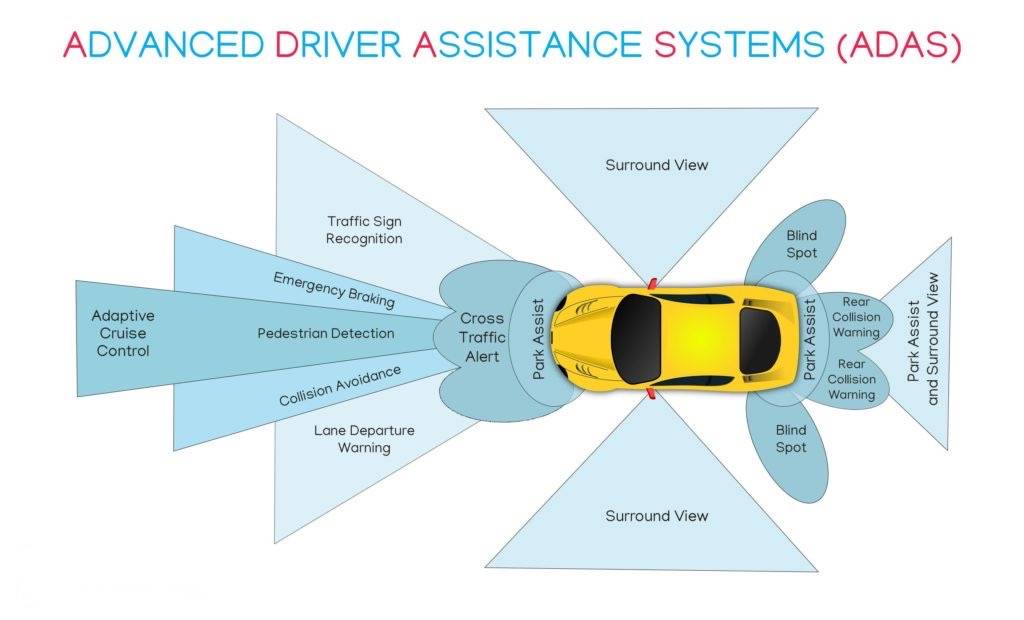
Start with the behavior you recognize. A warning, a brief steering correction and continuous lane centering are different functions, even when the names sound similar.
Lane departure warning LDW
Warns when you drift near or over a lane line. Look for a lane icon, tone or vibration.
Lane keeping assistance LKA
May steer or otherwise intervene to help stop an unintended departure. This is a corrective action near the lane boundary.
Lane centering assistance
Makes ongoing steering inputs to help hold the lane center while its operating conditions are met.
Adaptive cruise control ACC
Adjusts speed to maintain a selected following gap. A distance-bars button can be a clue; ordinary cruise control need not do this.
Forward collision warning FCW
Alerts to a detected crash risk ahead. The warning alone does not mean the car will brake.
Automatic emergency braking AEB
Can apply the brakes when it detects an imminent crash. It has limits and cannot prevent every collision.
Read the owner's manual for the exact conditions and limitations. Stay attentive and ready to take control. Never test a feature by deliberately drifting, tailgating or approaching an obstacle.
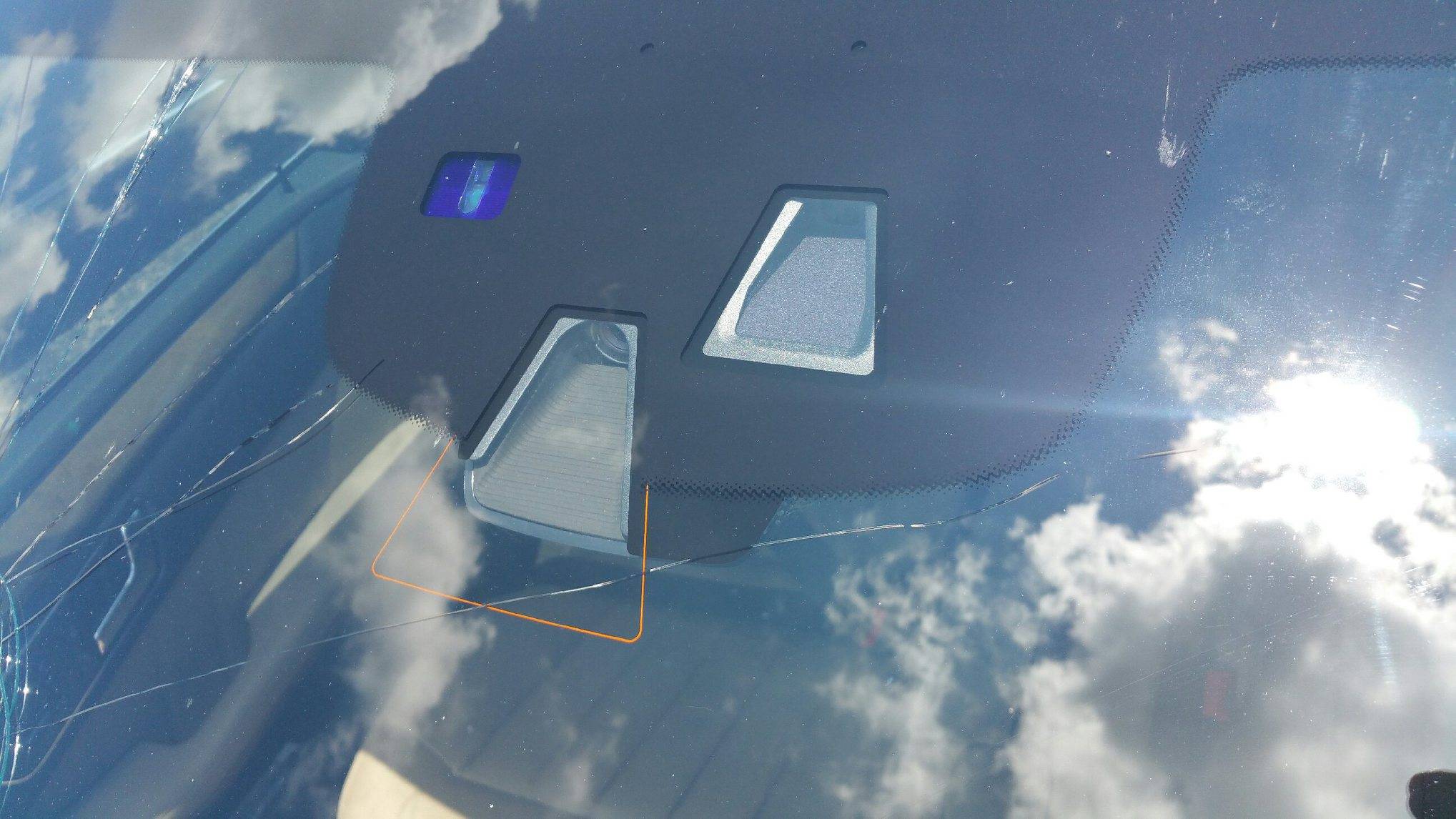
The black housing near your mirror may contain several different parts. A photo helps identify visible equipment, but its shape alone cannot confirm every option.
A package name such as EyeSight, Honda Sensing or Ford Co-Pilot360 is a useful clue. The brand cards explain familiar names; the vehicle-specific information identifies the actual equipment.
A head-up display, acoustic glass and windshield heating can change the required glass specification. Mention these when requesting a quote, even if you are unsure whether your vehicle has a front camera.
Backup and surround-view cameras, blind-spot sensors, parking sensors and front radar can be located away from the windshield. A windshield-camera procedure does not automatically cover those components.
Calibration establishes the camera or sensor's intended relationship to the vehicle and its surroundings. You may also hear terms such as aiming, initialization or relearn. The name is a starting point: the vehicle manufacturer's procedure explains the actual work required.
I-CAR explains calibration terminology | I-CAR's calibration and diagnostic process
American Honda's scan and calibration guidance
An ambient-light sensor can control when exterior lights switch on. Automatic high beams perform a different task: they may use a forward camera to detect lights ahead. A rain sensor can share a module with a light sensor, but that does not make it the road-facing ADAS camera. Tell the provider which functions your vehicle has, and let the equipment check establish what is installed.
HELLA's rain and light sensor explanation | Honda's automatic-high-beam example
There is a chip near the camera. Tell the glass provider exactly where the damage is. The camera viewing area needs vehicle-specific assessment before deciding whether a repair is suitable.
The camera is being reused. Reusing a camera does not settle whether calibration is required. The manufacturer's procedure for your vehicle determines the work after windshield replacement.
There is no warning on the dash. A quiet dashboard is not documentation that a required calibration was completed. Ask which procedure applies and what completion record you will receive.
A warning appeared after the work. Record the exact message and contact the service provider promptly. Follow the owner's manual and do not rely on the affected feature. A warning alone does not identify its cause; diagnosis may require a qualified repair facility.
Photos and menu names help with identification. They do not replace checking the glass specification, fitted equipment and manufacturer service information.
Call 210-793-7115 for a free quote or use the quote form. Mobile service is by appointment in San Antonio and nearby areas. We will review your vehicle details before confirming the glass, applicable calibration work and service arrangement.
Request a windshield quote | ADAS calibration service
Honda windshield guidance | Ford glass and calibration guidance | Back to brand finder
Reference review date: October 13, 2026