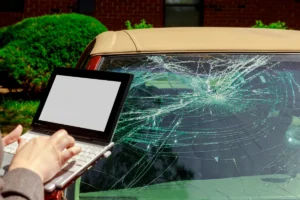

If your windshield cracked and you did not notice an impact, the original damage may have been easy to miss. A tiny impact mark can develop into a more noticeable crack later. Arrange an inspection rather than guessing the cause from the crack’s appearance.
Possible sources of impact damage include:
- A stray ball
- A tree branch falling on your car
- Ice pellets during a hailstorm
- Flying rocks or stones hitting the windshield while driving
The crack might not be noticeable at first, but given some time, it can expand to become more evident.
An inspection can help distinguish among the possible reasons a windshield may crack.
1. A small impact you did not notice
A crack can grow from an impact mark that is difficult to see. Nissan’s windshield-cracking guidance explains that some impact marks need magnification to identify, and that an impact crack can reach the edge and resemble a stress crack.
A technician should inspect the glass before deciding whether impact damage, a glass defect or another cause is involved.
2. Installation or glass condition
Improper mounting can put stress on a windshield, and manufacturing defects are another possible concern. A crack, wind noise or a wavy-looking area does not establish the cause on its own. Have the glass and its installation inspected, especially if the windshield was recently replaced.
3. Temperature changes and existing damage
Temperature fluctuations can create thermal stress and allow existing damage to spread. The cause of an individual crack still needs inspection; ordinary sunlight alone is not enough to identify it.
Avoid abrupt heating or cooling while awaiting assessment. Never pour hot water onto a frozen windshield. Our guides cover weather and auto glass and winter windshield care.
4. Can I drive with a cracked windshield?
If the damage interferes with your view, pull over as soon as it is safe and arrange assistance. Do not continue driving with an obstructed view. A crack that is spreading or reaches the edge also needs prompt professional assessment before further driving.
If you are unsure whether the vehicle can be driven safely, ask about mobile service or arrange towing. A description or photo alone cannot confirm that it is safe to drive.
5. Can it be repaired, or does it need replacement?
Repair suitability depends on the damage’s type, size, location, depth and condition, as well as any affected vehicle features. The ROLAGS repair standard calls for inspection and lists situations where replacement is recommended, including stress cracks.
Our rock chip repair page explains this shop’s repair criteria. A technician must assess the actual damage; not every crack qualifies for repair.
6. If windshield replacement is needed
Ask the shop what the replacement includes and when the vehicle can be driven again. Follow the minimum drive-away time given for the adhesive and installation conditions.
If the vehicle has windshield-mounted driver-assistance cameras, the shop should check the vehicle manufacturer’s calibration requirements. Learn about our ADAS calibration service; the correct procedure depends on the vehicle. These precautions are addressed in the AGRSS replacement safety standard.
A surprise windshield crack can be quite frustrating. But it doesn’t always have to be.
Auto Glass in San Antonio offers mobile services for windshield repairs and glass replacement services in San Antonio. Call us 24/7 for quotes and scheduling. Mobile appointments have limited availability.
With over 30 years of experience, we’re experts in auto glass repair and replacement.
To find out more, give us a call at (210)793-7115 or drop a message.